
 August 10th, 2025
  maricris
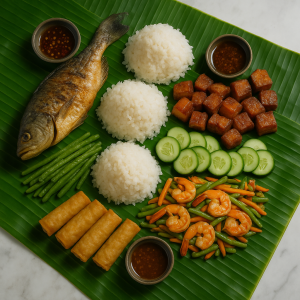
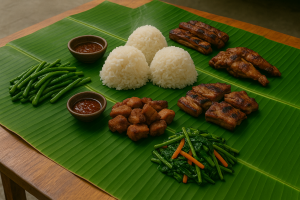
 I still remember the first time I joined a kamayan feast as a child, sitting cross-legged on the bamboo floor of my grandmother’s house in Uson. Banana leaves spread like a green tablecloth across the floor, fragrant piles of rice steaming at the center, fish fresh from the morning market, grilled pork, crisp vegetables, and dipping sauces glistening under the afternoon light. No forks. No spoons. Just our hands—warm, eager, and clumsy at first—lifting food to our mouths in a shared rhythm that felt older than language. It wasn’t just eating; it was communion, a silent promise that you were part of something whole.
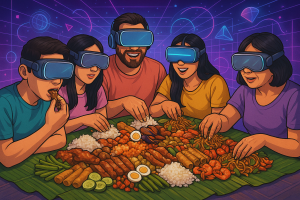
Fast forward to 2025, and I’m sitting in my apartment in Cawayan, wearing a haptic glove, looking at a virtual table through my VR headset. The banana leaves are rendered in such detail that I can see the tiny veins. Steam curls upward from digital rice mounds. My friends are there too—some in the next neighborhood, some halfway around the world. We’re about to have a kamayan feast together… in the Metaverse. And it’s both absurd and moving.
The fusion of a centuries-old dining ritual with immersive tech isn’t as random as it sounds. In 2025, Filipino cuisine is riding three overlapping cultural currents: the revival of traditional cooking, the embrace of globalized fusion, and the rapid adoption of food tech. Kamayan in the Metaverse sits right where these three meet. At first glance, it might seem like novelty—another gimmick in the endless parade of virtual experiences—but in practice, it’s revealing deep truths about identity, community, and the evolving ways we share a meal.
Traditional kamayan is more than just eating with your hands. It’s about physical closeness, the mingling of flavors and textures in real time, the act of reaching for food together in a shared space. In rural settings, it’s often tied to harvest celebrations or fiestas, where abundance is displayed and eaten collectively. The Metaverse version, of course, can’t replicate the smell of grilled tilapia or the stickiness of rice between your fingers—at least, not fully. But the newest haptic dining gloves have made shocking progress. They use micro-pressure nodes to simulate texture, and temperature-control pads to mimic warmth or coolness. Some even release faint scents in sync with what you “pick up.”
The question isn’t whether this is “as good as the real thing.” It isn’t. The question is whether it offers something different but equally valuable: a space where geography no longer dictates who can sit at your table. In the diaspora, where millions of Filipinos live oceans apart from their families, virtual kamayan dinners are becoming a quiet revolution. They’re not replacing the real gatherings—nothing could—but they’re filling the spaces between them. Families scattered across continents can now share the same meal in synchronized time, discussing the same lumpia and lechon as if they were in the same room.
This trend started with Filipino tech entrepreneurs in California and Singapore experimenting with VR pop-up dinners during the pandemic years. What began as “heritage food in VR” quickly grew into a hybrid movement: restaurants offering both physical kamayan events and their digital twin. A small but growing number of chefs are now designing menus specifically for the virtual experience, balancing visual appeal with the tactile limitations of current tech. In physical kamayan, sauce drips and messy hands are part of the charm; in the Metaverse, those moments are translated into satisfying “virtual stickiness” and perfectly simulated crunch sounds.
Critics call it a diluted version of tradition. And they’re right, to a point. There is an irreplaceable intimacy in passing a real piece of grilled fish to your uncle, or in watching your cousin sneak an extra slice of mango when they think no one’s looking. But the Metaverse kamayan adds layers that traditional dining can’t offer. Imagine eating side-by-side with relatives who live in Canada, while a historian narrates the origins of each dish in real time. Or attending a charity kamayan where your ticket funds coastal restoration in the Philippines, and the host is a holographic version of a famous chef guiding you through plating techniques.
There’s also a generational element. For younger Filipinos raised in sprawling, hyper-connected cities—or entirely abroad—food is often their first and deepest connection to heritage. Many can’t speak Tagalog or their family’s local dialect fluently, but they know the taste of sinigang or the feel of adobo sauce on their fingers. Bringing kamayan into the Metaverse speaks their language: a digital-first environment where identity is flexible and shared experiences are not bound by location. It’s less about “saving tradition” in its purest form, and more about letting it breathe in new air.
I attended my third virtual kamayan last month, hosted by a group called “Banana Leaf Futures,” a collective of chefs, technologists, and cultural workers. They shipped out meal kits to participants across the globe, each with instructions to prepare the dishes before logging into the VR event. The kits weren’t just food—they included banana leaves, dipping sauces, and printed cards with anecdotes from farmers and fishermen who supplied the ingredients. When we entered the Metaverse space, the table was set to mirror exactly what we had in front of us in real life. The haptic glove let me “touch” the pile of rice on the screen, while my actual hands were doing the same with the real food in my kitchen. The overlap between digital and physical created a strange, beautiful duality—I could see my cousin’s avatar in London scooping the same grilled eggplant I had, knowing she was tasting it at the same moment.
It struck me that this wasn’t replacing tradition—it was refracting it. Like light through glass, the essence of kamayan was still there: shared abundance, mutual presence, the act of feeding and being fed. But it was bent into new shapes by technology, reaching places the old form couldn’t. The Metaverse table might never smell like my grandmother’s kitchen, but it could hold my entire far-flung family at once, and that’s its own kind of magic.
Filipino food has always been adaptive. It absorbed Chinese noodle-making, Spanish stews, American fast food, and Japanese convenience culture without losing its soul. Kamayan in the Metaverse is simply the latest wave in this long story of blending. It’s not the final form, either. As VR hardware becomes cheaper and sensory tech more refined, the experience will get closer to “being there.” Maybe one day, we’ll have aroma diffusers smart enough to replicate the scent of freshly grilled bangus exactly, or gloves that can simulate the tenderness of ripe mango flesh down to the fibrous detail.
But even if that never comes, the point isn’t perfection—it’s connection. In the end, kamayan was never about the tools, the leaves, or even the dishes themselves. It was about the people gathered around; however, they could not share food with their own hands. In 2025, those hands might be wearing haptic gloves, reaching across continents instead of across the table. And that’s still Kamayan.
 Posted in
  Tags:
Tags: